


 Login with Facebook
 Login with Google
 Login with LinkedIn

Top rated
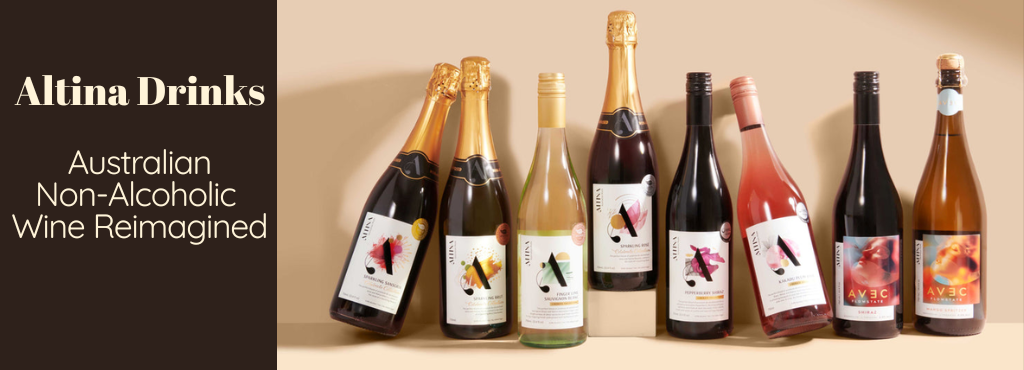
Altina Drinks: Australian Non-Alcoholic Wine
Altina Drinks: Australian Non-Alcoholic Wine Reimagined with Native Botanicals
Altina Drinks has emerged as one of Australia’s most distinctive non-alcoholic wine producers. The brand builds its range from de-alcoholised Australian wine, then layers in native botanicals such as finger lime, rosella, riberry, pepperberry and wattleseed. That production choice matters. It places Altina closer to wine than to soft drink, and it helps explain why the range is often discussed in terms of structure, acidity and balance rather than sweetness alone.
CellarsMarket’s own Altina brand page presents the house style clearly. Altina products are described as premium alcohol-free wines and botanical wine alternatives, with alcohol levels below 0.5% ABV, and a portfolio spanning sparkling expressions, rosé, red and sangria-inspired styles. The page also stresses a central point: these drinks begin as real Australian wine before alcohol is removed.
That positioning aligns with a wider shift in beverage culture. Wine Australia reports that no-alcohol wine consumption increased at 13% per year over the five years to 2023, reaching 4.5 million cases globally, while low-alcohol wine rose even faster. Meanwhile, the Australian Bureau of Statistics found that 26.8% of adults aged 18 and over exceeded the alcohol guideline in 2022, reinforcing why moderation has become commercially and culturally significant.
This article examines Altina Drinks as both a brand and a case study. It explores the company’s story, flavour architecture, consumer appeal, market context, food matching potential and retail relevance. A simple recipe is also included, showing how Altina can move from shelf to serve without losing its wine-like identity.
At a glance
-
Australian non-alcoholic wine brand using de-alcoholised wine and native botanicals.
-
Portfolio includes sparkling, rosé, red and botanical wine alternatives.
-
Products are listed at less than 0.5% ABV.
-
Brand story centres on Alan and Christina, who launched Altina in 2018.
-
Native ingredients are used for dryness, complexity and a more adult flavour profile.
-
Category growth is strong, though still small compared to conventional wine.
The Altina story: a modern Australian response to drinking culture
Altina’s official story gives the brand a recognisably Australian foundation. Alan and Christina started the business in 2018 after reflecting on their own experiences with local drinking culture. Their stated mission was to create a new way for Australians to socialise, while also celebrating nature, science and experience. Those words are more than branding decoration. They help explain why Altina sits between wine craft, flavour science and lifestyle design.
A notable part of the founding narrative concerns formulation. The company says Christina avoided the common shortcut of adding sugar to create body after alcohol removal. Instead, Altina relies on natural ingredients and native botanicals to build nuance and length. This decision is central to the brand’s identity because many consumers still assume alcohol-free wine will be flat, jammy or confected. Altina addresses that expectation directly through dryness and aromatic complexity.
The official site also notes that Altina’s wines have been recognised at the World Alcohol Free Awards and through other accolades. That claim is useful because the non-alcoholic category still depends heavily on trust signals. Awards, expert endorsements and repeat retail listings can reassure drinkers who may be sceptical about quality. In wine-adjacent categories, perception often shifts only after consumers encounter evidence of craft.
From a retail perspective, this backstory is compelling because it gives the brand a clear point of difference. Altina is not presented as a compromise product. Instead, it is framed as a considered beverage built for occasions where ritual matters but alcohol does not. That distinction has become increasingly important as moderation moves from niche behaviour to mainstream practice.
What makes Altina different from many alcohol-free alternatives
The CellarsMarket brand page highlights three key pillars: real Australian wine, gentle dealcoholisation, and native botanical infusion. Together, these create a product style that aims to preserve wine character while broadening the aromatic palette. Rather than imitating a single grape expression as closely as possible, Altina appears to embrace a broader sensory design philosophy.
That strategy has practical flavour advantages. Alcohol carries aroma, texture and warmth. Once it is removed, a drink can feel thin or hollow. Producers, therefore, need another route to shape palate weight and finish. Botanicals offer that route. Finger lime can sharpen brightness. Rosella can add tart red-fruit tones. Pepperberry can contribute spice. Wattleseed may suggest roasted, savoury depth. Riberry can bring a lift that recalls berry fruit while remaining distinctly Australian.
Altina’s official story adds another useful distinction: the company says it does not add sugars, sweeteners, or juice concentrate to its beverages. That matters because sweetness can hide structural weakness, yet it can also move a drink away from the food-friendly qualities many wine drinkers seek. Dryness, by contrast, makes pairing easier and helps position the range for more mature palates.
An expert observation from IWSR helps explain why this matters in market terms. Susie Goldspink, IWSR’s Head of No & Low Alcohol, said that no-alcohol analogues are becoming increasingly popular because they let drinkers moderate while still participating fully in occasions without feeling left out. Altina’s format speaks exactly to that need. It provides visual familiarity, shared-occasion relevance and sensory complexity in one package. (IWSR)
The Altina range: style, structure and likely drinking occasions
CellarsMarket lists Altina’s product families as sparkling wines, rosé wines, red wines and botanical wine alternatives. Specific products on the page include Sparkling Brut, Sparkling Rosé, Le Blanc, Kakadu Plum Rosé, La Vie En Rosé, Pepperberry Shiraz and Sparkling Sansgria. That lineup suggests a deliberately occasion-led range, covering aperitif moments, food pairing, celebratory serves and casual social occasions.
The sparkling segment is especially important. Sparkling drinks often perform well in non-alcoholic settings because carbonation adds texture and lift. It can compensate for some of the palate volume lost during dealcoholisation. CellarsMarket notes that Altina’s sparkling styles pair well with seafood, oysters, salads and light pasta dishes. That pairing advice signals crispness, acidity and a relatively dry finish.
Rosé expressions, including Kakadu Plum Rosé and La Vie En Rosé, appear positioned toward Mediterranean dishes, grilled vegetables and summer dining. In wine retail, rosé often succeeds through versatility. A non-alcoholic rosé must therefore balance fruit approachability with enough savoury restraint to avoid reading as cordial. Altina’s use of native ingredients gives it a route to that balance.
The red category is represented by Pepperberry Shiraz, which CellarsMarket recommends with roasted vegetables, mushroom dishes and barbecue foods. That suggestion is revealing. A successful alcohol-free red must supply tannin-like grip, spice and enough flavour persistence to stand beside umami-rich dishes. Pepperberry, as a botanical cue, supports the expectation of warmth and savoury depth.
Then there is Sparkling Sansgria, filed under botanical wine alternatives. This product matters because it shows Altina is not confined to classic wine mimicry. The brand can also move into hybrid territory where wine ritual, botanical layering and occasion design meet. For retailers, that flexibility broadens the audience. Some shoppers want familiar wine forms. Others seek novel adult drinks that simply happen to be alcohol free.
Why the market is ready for brands like Altina
Wine Australia’s 2025 market bulletin offers a grounded picture of category growth. According to IWSR data cited there, global no-alcohol wine consumption reached 4.5 million cases by 2023 after growing 13% annually over five years. Low-alcohol wine grew at 21% annually to 3.3 million cases. Although still wine remains vastly larger, the no- and low-alcohol segments are expanding in a way that traditional wine cannot ignore. (wineaustralia.com)
The same source stresses proportion. Combined no- and low-alcohol wine still represents a very small share of overall still wine sales, projected to rise from 0.2% in 2018 to 0.7% in 2028. That nuance matters. It prevents exaggerated claims while still confirming a strong growth trajectory. For Altina, this means opportunity exists, but competition for attention, education and trial will remain intense. (wineaustralia.com)
Australia occupies an especially relevant place in this story. Wine Australia reports that three-quarters of global no-alcohol wine consumption in 2023 came from five markets, including Australia. That makes the domestic market meaningful both symbolically and commercially. Altina’s Australian identity therefore works at two levels: it speaks to local consumers while also aligning with a country already recognised within the category’s top markets. (wineaustralia.com)
A broader IWSR release from January 2026 adds further momentum. The organisation expects global no-alcohol analogue volume to have grown by 9% in 2025 and forecasts 36% volume growth between 2024 and 2029. Even though this figure spans beer, wine, RTDs and spirits, it supports the larger moderation trend that brands like Altina rely upon. (IWSR)
Public health data provides another layer. The ABS found that more than one in four Australian adults exceeded the alcohol guideline in 2022. Younger adults aged 18 to 24 were the most likely to do so. These statistics do not automatically convert into alcohol-free purchases, yet they do illuminate why moderation, substitution and occasion management have become part of everyday conversation. (Australian Bureau of Statistics)
What consumer research suggests about acceptance
A 2024 peer-reviewed Australian study published on ScienceDirect gives important context for category barriers and opportunities. The study collected data from 679 Australian survey respondents and 32 tasting participants between 2020 and 2022. Researchers found high awareness of non-alcoholic options, but many respondents were initially unwilling to try them. Experience, however, improved perceptions, especially around taste, and positively influenced behavioural intention to consume and willingness to pay. (ScienceDirect)
That finding is highly relevant for Altina. It suggests that trial is one of the brand’s most valuable commercial tools. Consumers often approach alcohol-free wine with a memory of older, sweeter or less convincing products. Once they taste a dry, botanically complex expression, the category can be reconsidered. This is where sampling, staff recommendation, gifting and food pairing all become strategic. (ScienceDirect)
The same study also found that pricing in Australia remains above many consumer expectations. That is a familiar challenge across premium no-alcohol categories. Consumers sometimes compare alcohol-free wine to soft drinks, ignoring production costs linked to winemaking, dealcoholisation, packaging and quality ingredients. For brands such as Altina, education must therefore accompany premium positioning. The shopper needs to understand what is being paid for. (ScienceDirect)
Real-world retail experience supports this interpretation. When a customer already values wine ritual, flavour layering and careful food matching, Altina is easier to position. The task becomes harder only when the shopper is seeking the cheapest alcohol-free refreshment. Altina is best understood as a crafted wine alternative rather than a simple substitute beverage.
Native botanicals and the Australian flavour identity
Native botanicals are not just a decorative talking point in Altina’s range. They are central to how the drinks achieve personality. Finger lime delivers brightness and aromatic tension. Rosella can add tart florals and crimson fruit suggestions. Riberry offers vivid berry character with lift. Pepperberry introduces spice. Wattleseed contributes a toasted, earthy register that can deepen the finish. CellarsMarket lists several of these ingredients directly on its Altina page.
This botanical approach gives Altina a genuinely Australian flavour language. Many non-alcoholic wines globally aim to replicate European varietal norms with increasing precision. Altina appears to follow a different route. It starts with wine, yet it allows Australian ingredients to shape the final expression. As a result, the drinks become not merely alcohol-free versions of something else, but products with their own regional voice.
That matters for brand storytelling and export potential. Consumers increasingly value provenance. In conventional wine, place remains a powerful signal of worth. In the alcohol-free category, terroir is harder to communicate because the production process already departs from tradition. Botanicals offer a new path. They let a producer express local identity in aromatic and flavour terms even after alcohol removal. Altina’s Australian roots are therefore reinforced in the glass, not only on the label.
Food pairing: where Altina performs best
CellarsMarket’s pairing suggestions offer a useful framework. Sparkling styles are recommended with seafood, oysters, salads and light pasta. Rosé is linked with Mediterranean cuisine, grilled vegetables and summer dishes. Pepperberry Shiraz is suggested for roasted vegetables, mushroom dishes and barbecue foods. These are sensible matches because they favour acidity, herbaceous freshness, umami and spice rather than heavy protein and alcohol warmth.
In practice, Altina’s strongest pairings are likely to be dishes where seasoning, texture and aromatic lift matter as much as sheer body. A sparkling expression can shine beside zucchini flowers, snapper crudo, burrata with citrus dressing or a fennel salad. Rosé can sit happily with grilled capsicum, tomato tarts, couscous salads or charred eggplant. Pepperberry Shiraz should work best with mushrooms, lentils, smoky aubergine, glazed carrots or barbecue cauliflower. Those pairings respect the range’s likely structural strengths.
This matters because food pairing remains one of the clearest ways to elevate non-alcoholic wine from curiosity to staple. Once a drink proves itself at the table, repeat purchase becomes more likely. Altina’s dryness and botanical complexity make that transition easier than sweeter alternatives would.
A simple Altina serve recipe: Pepperberry Garden Spritz
This recipe is designed for readers who want a wine-like mixed serve without overwhelming Altina’s character.
Ingredients
-
120 millilitres Altina Pepperberry Shiraz
-
40 millilitres chilled brewed hibiscus tea
-
20 millilitres verjuice
-
60 millilitres chilled soda water
-
3 thin slices of fresh strawberry
-
1 small strip of orange zest
-
2 basil leaves
-
Ice
Method
Fill a large stemmed glass with ice. Add the strawberry slices and one basil leaf. Pour in the Altina Pepperberry Shiraz, hibiscus tea and verjuice. Stir gently for five seconds. Top with soda water. Express the orange zest over the glass, then drop it in. Garnish with the remaining basil leaf.
Why it works
The hibiscus tea amplifies red-fruit tartness without adding heavy sweetness. Verjuice sharpens structure and length. Soda water lightens the palate for warm-weather drinking. Basil and orange add lift while keeping the serve savoury. Altina remains the core flavour, rather than becoming a background ingredient.
Best food match
Serve with mushroom skewers, grilled aubergine, rosemary potatoes or smoky lentil patties.
Who is Altina really for?
CellarsMarket’s FAQ points to several user groups: people pursuing mindful drinking, pregnant women, athletes and professionals seeking wine flavour without alcohol. That list captures the category’s diversity. It is no longer accurate to imagine alcohol-free wine as a single-purpose product reserved for abstainers. Increasingly, it serves flexible drinkers who move between alcoholic and non-alcoholic options according to time, setting and personal goals.
One consumer segment values social inclusion. They want a stemmed glass, an adult flavour profile and an elegant bottle on the table. Another values wellness or next-day functionality. A third is motivated by pregnancy, training cycles or work commitments. Altina’s design suits all three because it retains the visual and ritual cues of wine while removing the practical drawbacks of alcohol.
The peer-reviewed Australian study noted that prior experience improves liking and willingness to purchase. That implies Altina may perform especially well with curious wine drinkers who are open to exploration but need a confident first encounter. Retailers, hosts and hospitality venues all play a role here. Presentation and recommendation can shape whether trial becomes adoption. (ScienceDirect)
Final assessment
Altina Drinks deserves attention because it approaches non-alcoholic wine as a category of craft, not merely compliance. The brand begins with de-alcoholised Australian wine, uses native botanicals for complexity, avoids an overtly sugary style, and presents a range suited to genuine food pairing and adult occasions. (cellarsmarket.com.au)
Its relevance is strengthened by broader market and cultural conditions. Wine Australia data confirms strong category growth, even from a small base. IWSR sees continued momentum across no-alcohol analogues. Australian public health data shows why moderation is not a passing conversation. Consumer research then adds a practical conclusion: tasting and education are crucial, because perceptions improve once people experience quality. (wineaustralia.com)
Within that landscape, Altina stands out by sounding and tasting unmistakably Australian. Finger lime, rosella, pepperberry and wattleseed do more than add novelty. They give the range identity, structure and a regional signature. For CellarsMarket readers, that is the most persuasive reason to pay attention. Altina is not simply alcohol-free wine. It is a thoughtful reworking of what contemporary Australian drinking can look like.